So, about that tie...

In 1990, I watched live images of Nelson Mandela walking out of Victor Verster Prison, taking his first steps into a free world. It was a moment that signaled the beginning of the end for one of the 20th century’s most codified systems of racial subjugation. Years later, in 2016, I traveled to South Africa, walking through a nation still grappling with its past through the monumental legacy of its Truth and Reconciliation Commission.
But my connection to this history isn’t just academic or personal. As a former Foreign Service Officer, I swore an oath to represent the United States with honor and objectivity.
That is why it was with a mixture of profound disbelief and historical vertigo that I watched U.S. Deputy Secretary of State Christopher Landau welcoming a select group of Afrikaner refugees. Standing there, representing the department I served, Landau wore a tie proudly bearing the distinct orange, white, and blue stripes of the old, Apartheid-era South African flag.
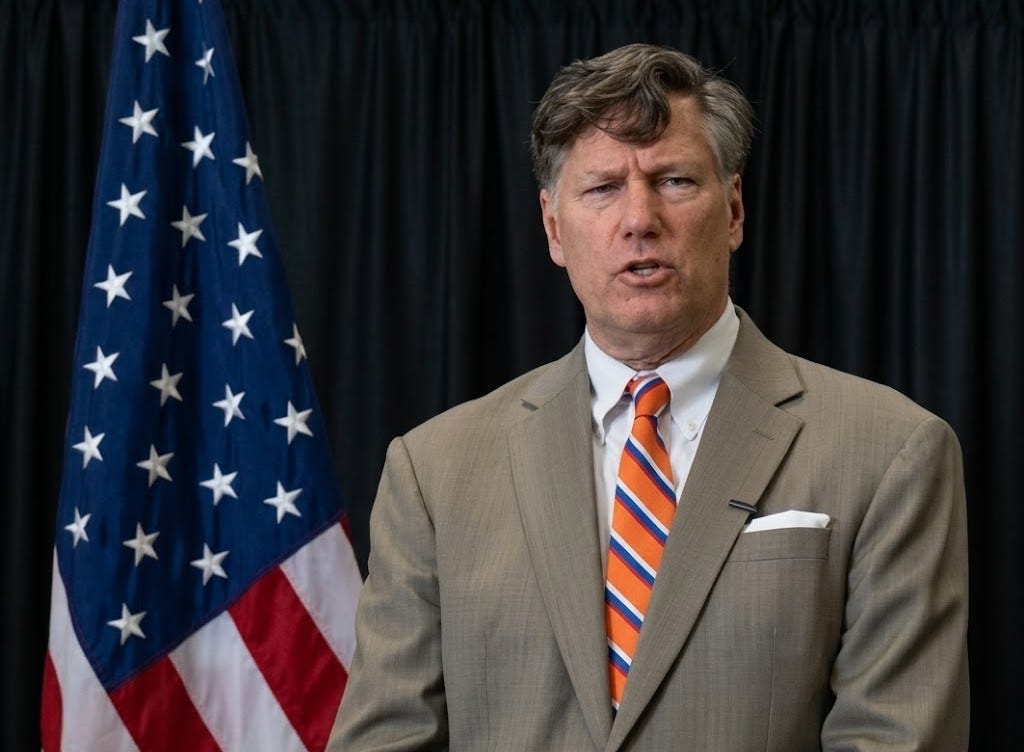
If a picture is worth a thousand words, Landau’s neckwear spoke volumes about a troubling, deeply dishonest shift in American humanitarian policy.
The State Department has increasingly weaponized the U.S. refugee program, distorting it to fit a politically motivated, fringe narrative of “white genocide” in South Africa. In early 2025, the administration carved out a highly specific, fast-tracked refugee resettlement program explicitly catering to white South Africans. This occurred simultaneously as the administration suspended refugee applications from war-torn, existential humanitarian crisis zones.
To see a high-ranking American diplomat stand in an airport hangar, handing out American flags to a single, racially selected group while draped in the color scheme of minority rule, is a grotesque subversion of American values.
When this stunt happened, I went home feeling sick to my stomach. As a career diplomat and retired military officer with vast experience in international affairs, I knew the immediate, devastating institutional fallout of this cynical dishonesty. I found myself wondering: how could our career personnel serving in Pretoria, Cape Town, and Durban look their South African counterparts in the eye? How could they be expected to promote this fabricated narrative to a host government with whom we share critical strategic ties, without utterly destroying America’s credibility?
Landau, of all people, should know better. During the arrival ceremony, he invoked his own family history, noting that his father had to flee Austria when Hitler marched in. It is a poignant history of escaping systemic hatred. Yet, instead of using that familial legacy to champion a fair, colorblind, and equitable refugee system for all marginalized peoples, Landau chose to validate a dishonest, racially tribalist narrative.
The U.S. Department of State is meant to project American ideals of democracy, human rights, and the rule of law to the world. When its second-highest-ranking official signals a nod to an era of racial segregation through a calculated choice of wardrobe, it isn’t just a fashion faux pas. It is a badge of dishonesty, exposing a foreign policy that has abandoned objective humanitarian need and institutional integrity in favor of ideological pandering.